
A summarised version of an article by Luke Sheather, published by Betashares (19 July 2023). Reused with permission.
Many investors hesitate before putting money into markets, worried they’ll buy at the wrong time. But is that worry justified? A study by Betashares, replicating research originally conducted by Charles Schwab in the US, tested this question using 22 years of Australian market data (January 2001 to December 2022).
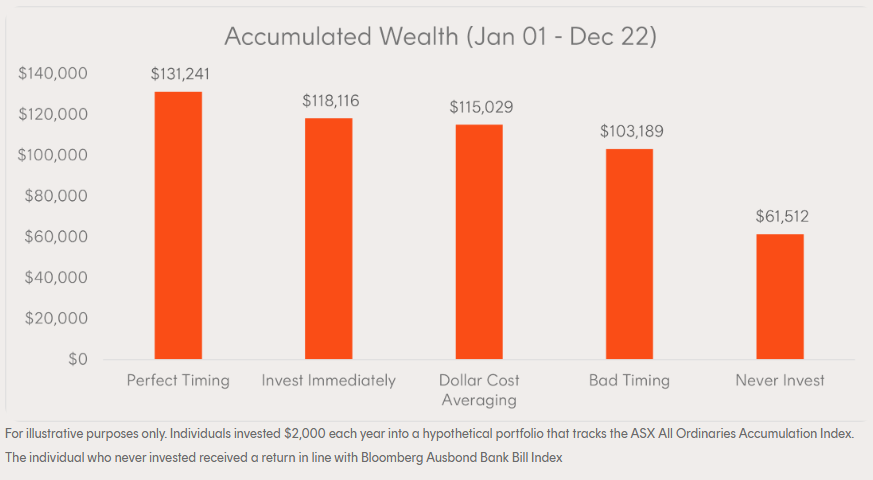
The study imagined five investors, each receiving $2,000 at the start of every year, but each using a different approach:
- Lucky Leo invested his $2,000 at the market’s lowest point every single year — a level of timing skill no real investor could realistically achieve.
- Rapid Riley didn’t try to time anything. She simply invested her $2,000 on the first trading day of each year.
- Steady Eddy used dollar cost averaging, splitting his $2,000 into 12 equal monthly instalments.
- Hopeless Harry had the worst luck imaginable, investing his $2,000 at the market’s peak every year.
- Hesitant Hayley never invested at all, leaving her money in a bank account earning interest only.
The results after 22 years:
1. Leo (perfect timing) finished first — but only by roughly $13,000 more than Riley.
2. Riley (invest immediately, no timing) placed second.
3. Eddy (dollar cost averaging) came third, about $3,000 behind Riley.
4. Harry (worst possible timing) still ended up around $15,000 behind Riley — but far ahead of…
5. Hayley (never invested), who missed out on roughly $41,000 compared to Harry, despite Harry buying at the worst possible time every year.
To confirm this wasn’t a one-off result, the same test was run across 24 different 20-year periods since 1980, plus various 30- and 40-year windows. The ranking order never changed: perfect timing wins, investing immediately beats dollar cost averaging, and even terrible timing beats not investing at all.
With ongoing headlines about geopolitical tension, inflation and market volatility, it’s a common and understandable instinct to want to wait for “the right time” to invest, or to retreat to cash when markets get rocky. But as the numbers above show, staying invested, even through periods of poor timing, tends to beat sitting on the sidelines.
The lesson isn’t that timing doesn’t matter, or that markets won’t fall — they will, and sometimes sharply. The lesson is that trying to predict those falls and moving in and out of the market around them, is extraordinarily difficult to get right consistently. Investors who wait for calmer conditions can also miss the recovery that follows a downturn, since some of the strongest periods of growth tend to arrive shortly after the worst ones.
Key takeaways
- Time in the market beats timing the market. Even an investor with the worst possible timing came out well ahead of someone who stayed in cash. Staying invested matters more than getting the entry point exactly right.
- Waiting for the “right time” carries a real cost. Since consistently picking market bottoms isn’t realistic, having a clear plan and sticking to it tends to serve investors better than trying to time entries.
- Dollar cost averaging still has a place. Although it gave up some returns compared to investing immediately, spreading contributions over the year can ease the psychological discomfort of investing a lump sum, while still avoiding the trap of trying to time the market.
- Professional timing is hard too. Even professional fund managers struggle — SPIVA data shows about half of professional stockpickers underperformed the S&P/ASX 200 over a one-year period.
- For long-term wealth creation, what matters more than timing is having a portfolio you can stick with and build over time: a clear strategy, sensible diversification, appropriate asset allocation, and the discipline to stay the course when headlines get noisy.
Reference: Sheather, L. (2023, July 19). What is the best time to invest your money? Betashares.
Thinking about your own portfolio?
Whether you’re feeling hesitant about when to start, tempted to wait for calmer headlines, or just need a bit of encouragement to stick with your plan when markets get noisy, that’s exactly the kind of thing we’re here for. We’d welcome the chance to talk it through with you and make sure your strategy is one you can comfortably stay the course with. Get in touch with the team at dmca advisory to review your plan.